A green badge on an under-construction home is not a certificate. It is a pre-certification: a developer's plan, reviewed on paper, that may or may not match the finished building. Few buyers know the difference, and even sellers struggle to explain it. When the Prayas Energy Group studied projects at a CREDAI property expo in Pune in January 2025, it found brochures that carried only the IGBC logo, with no list of green features, and sales staff unable to explain the rating.
For anyone considering IGBC certified homes in Hyderabad, that gap matters. A green certificate can signal real, lasting value, or very little at all. This guide explains how to tell the difference in three parts: the promise, the proof and the payoff.
What IGBC and LEED Certification Actually Mean
A green certificate is an independent rating of how a building uses resources. In India, homes are most commonly rated under one of two systems. The Indian Green Building Council (IGBC) was set up by the Confederation of Indian Industry in 2001 and is designed around Indian climate and construction practices. LEED is the American system, run by the US Green Building Council and used worldwide.
Both work in a similar way. A project earns points for measures such as water conservation, energy efficiency, sustainable materials, waste handling and indoor air quality. The total decides the rating level, from the entry-level "Certified" up to Platinum.
The Promise: Pre-Certified Is Not Certified
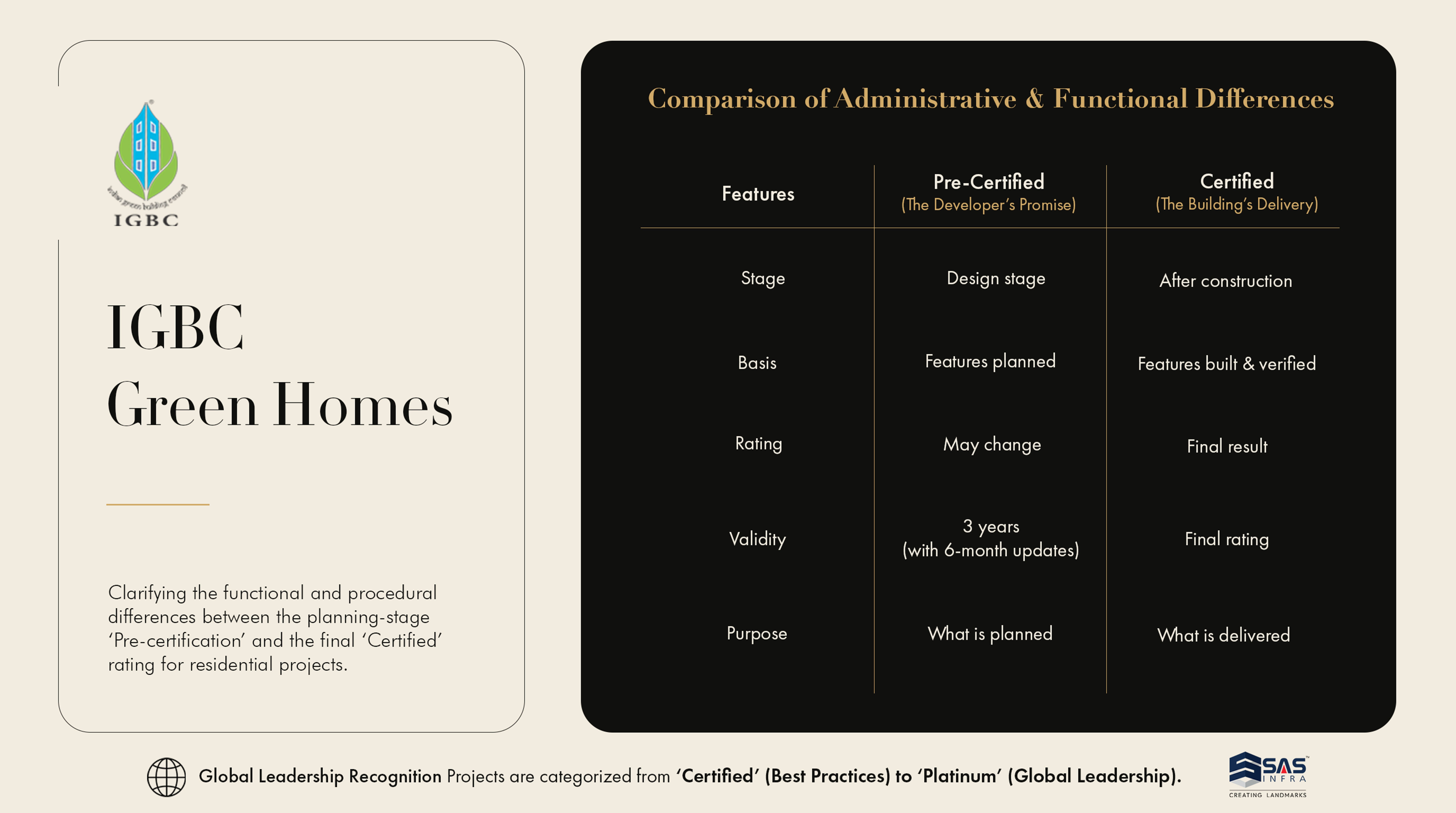
IGBC allows developers to apply for pre-certification at the design stage. The rating is based on the features the developer plans to build, not on a finished building, and IGBC itself notes that a pre-certified rating need not correspond to the final certification. Pre-certification is valid for three years, and projects must submit progress updates every six months until the final rating is awarded after construction.
None of this makes pre-certification meaningless. It shows that a developer has committed, in detail, to a green design, and that an independent body has reviewed the plan. But a plan is a promise. The final certificate, awarded once the features are actually in place, is the proof.
The Proof: How to Check a Green Claim
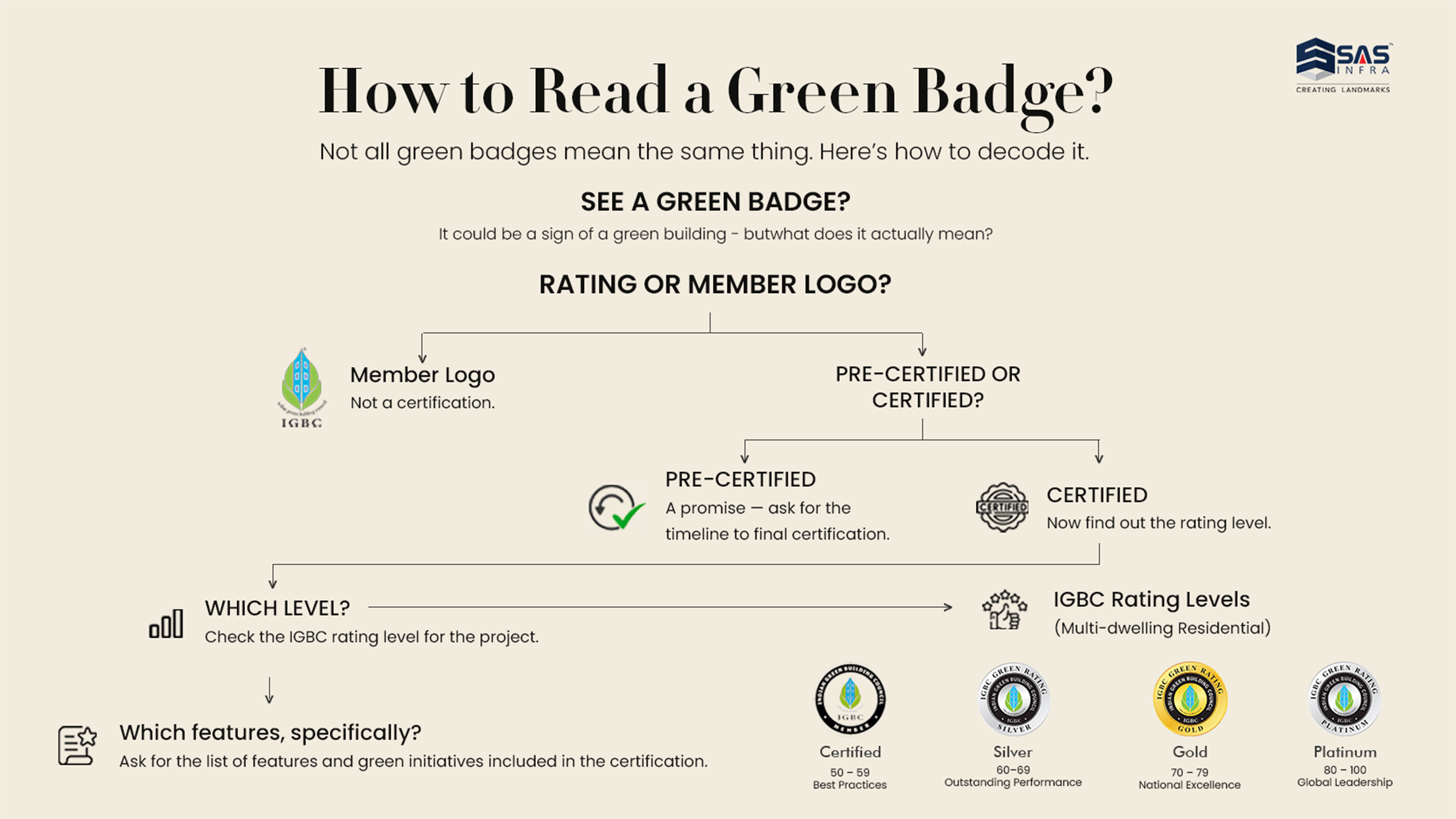
Checking a green claim comes down to three questions. Is the rating a pre-certification or a final certification? Which level has been awarded? And which green features, specifically, has the project committed to?
The last question matters more than it seems. The Prayas study also found that some developers displayed an IGBC member logo on their brochures even though the projects themselves were not certified. Membership of the council is not a rating.
A transparent claim answers all three questions openly. SAS iTower, for example, is being built to LEED Gold standards, with the final rating to be awarded by the US Green Building Council on completion. Buyers should expect the same clarity from any residential project.
The Payoff: Why Green Matters More in Hyderabad
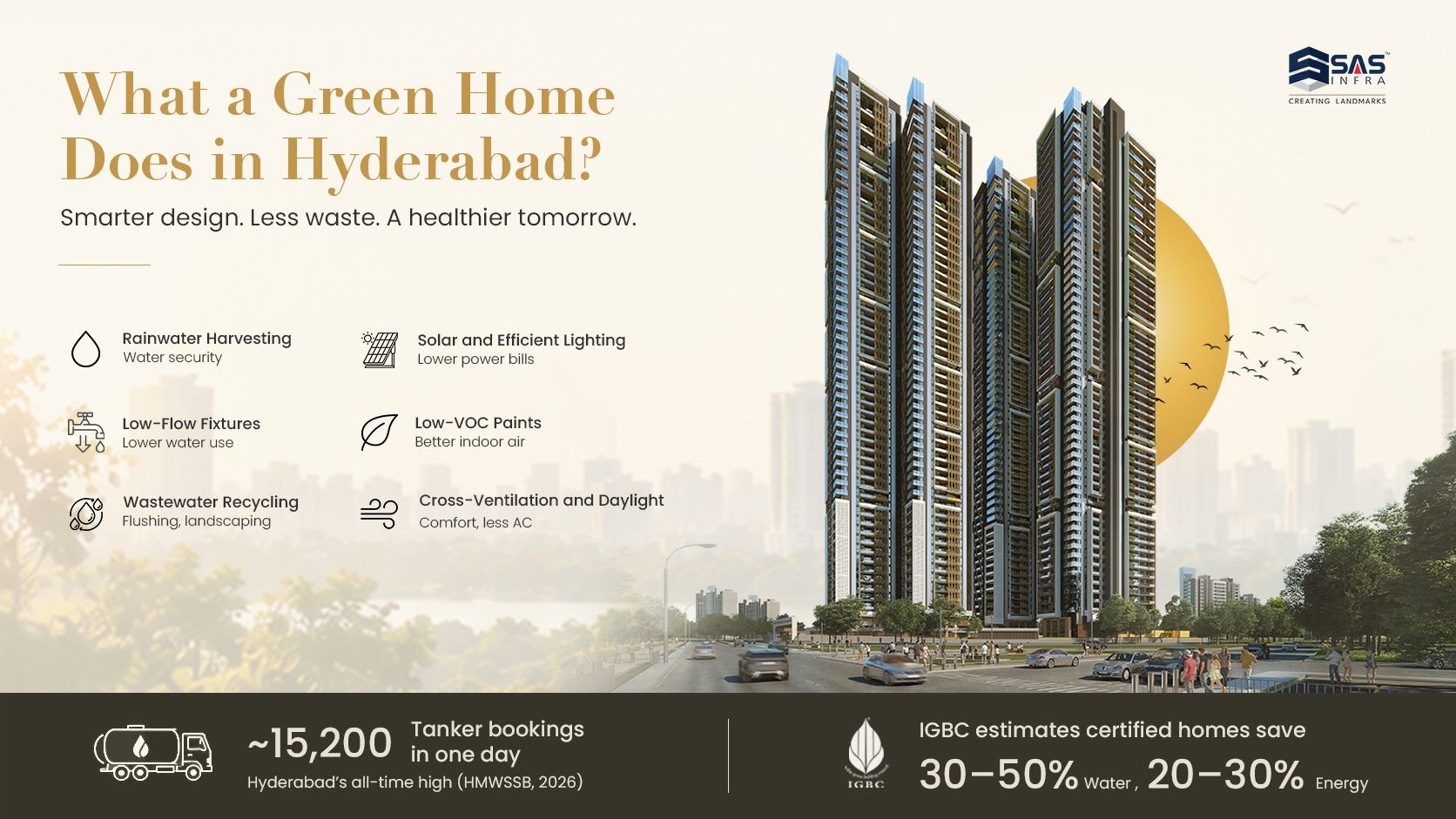
For a Hyderabad home, the green features that matter most are the ones that deal with water. This summer, the city's water board, HMWSSB, recorded an all-time high of about 15,200 tanker bookings in a single day, with the western corridor among the worst-affected areas as groundwater levels fell.
Green-rated homes address this directly through rainwater harvesting, water-efficient fixtures and the recycling of wastewater for uses such as flushing and landscaping. IGBC estimates that its certified homes can save 30–50% of water and 20–30% of energy compared with conventional buildings. These are IGBC's own estimates rather than measured results for any single project, and actual savings depend on how a building is run.
The value of those savings grows with the size of the home, because a percentage cut applies to the whole bill. And where groundwater is falling and tanker demand keeps rising, lower dependence on tankers and borewells may be worth more than the savings themselves.
The Premium Question: Does It Add to Resale or Rent?
Many property websites claim that green homes resell or rent for 10–15% more. Those figures are rarely backed by any named study. The more useful question is not how large the premium is, but why a certificate should create one at all.
The answer lies in what a buyer cannot see. Insulation, efficient fixtures and water-recycling systems sit behind walls and under floors. When a home comes up for resale, the next buyer has no easy way to judge them. A final certificate settles the question: it is independent proof, issued by a recognised body, that a future buyer can check.
Where transaction data exists, this effect can be measured. A 2017 study of Singapore's housing market, published in the journal Economics Letters, found that green certification raised apartment prices by around 3% per square metre, and by 4.1% in developments whose green features were less obvious to buyers. Much of the premium, in other words, comes from the certificate itself, because it tells buyers what they could not otherwise verify.
A certificate can also carry financial benefits. Some lenders, including Union Bank of India through its Union Green Home scheme, offer home loans specifically for IGBC-certified projects, though such offers remain few.
India does not yet have the data to confirm a premium of its own. A 2024 study by IIM Tiruchirappalli for the National Housing Bank found reliable resale and rental records too scarce to measure one directly. Builders it surveyed estimated a sale premium of about 6%, while green features added roughly 3.5–4% to construction costs.
The evidence points in one direction. A premium is plausible, markets that track the data support it, and it depends on a verified certificate rather than a logo. Buyers should treat any specific figure with caution, but they should not dismiss the role a certificate plays in how a home is valued later.
What the Badge Should Tell You?
A green badge is neither a guarantee nor a gimmick. Read through the lens of promise, proof and payoff, it tells a buyer three things: what a developer has committed to, whether that commitment has been verified, and what it will mean for daily life in the home.
For IGBC certified homes in Hyderabad, that payoff is clearest in water, the resource the city is shortest of. A genuinely certified home is not only a greener choice. It is a more secure one.